
Flange bolt selection is critical for secure piping systems; detailed size charts, like those found in BS10 Table D, E, F, and H, are essential.
Understanding bolt circle diameter and length, alongside flange dimensions, ensures proper assembly, referencing ASME B16.5 specifications and DIN 2501 standards.
PDF resources offer comprehensive flange bolt information, including AWWA C110, C153, and AVK 350 charts, aiding in accurate bolt sizing for various flange types.
Importance of Correct Bolt Selection
Selecting the correct flange bolts is paramount for maintaining the integrity and safety of piping systems. Incorrect bolt sizing – whether diameter, length, or material grade – can lead to leaks, system failures, and potentially hazardous situations.
Precise bolt selection ensures proper clamping force, distributing stress evenly across the flange connection. Referencing detailed charts (like those in BS 10 Table D) and standards (ASME B16.5) is crucial. Utilizing PDF resources detailing bolt patterns and dimensions, alongside understanding gasket and washer requirements, minimizes risks and optimizes performance.
Proper bolt choice directly impacts the longevity and reliability of the entire system.
Overview of Flange Types
Flanges come in various types, each influencing bolt selection. Common types include Weld Neck, Slip-On, Blind, and Socket Weld flanges, each with unique dimensions and bolt circle requirements. Raised Face and Flat Face flanges necessitate different bolt lengths due to gasket compression.
Ring Type Joints (RTJ) flanges require specialized bolts and gasket considerations. Understanding the flange’s pressure class (e.g., 150#, 300#, 600#) is vital, as it dictates bolt material and quantity. PDF resources often categorize bolts by compatibility with specific flange types, aiding in accurate selection.
Correct identification of the flange is the first step in choosing the appropriate bolts.

Flange Standards and Specifications
Flange standards like ASME B16.5, BS 10, and DIN 2501 define dimensions and bolt patterns; PDF documents detail these specifications for accurate sizing.
ASME B16.5 Flange Standards
ASME B16.5 governs the dimensions, materials, tolerances, and bolt hole patterns for flanges and flange fittings. PDF versions of this standard are crucial for engineers and technicians involved in piping system design and installation.
The standard details nominal pipe size, bolt circle diameter, and the number of bolts required based on flange pressure class (e.g., 150, 300, 600). It provides tables outlining bolt sizes and lengths for various flange combinations, ensuring proper sealing and structural integrity.
Understanding ASME B16.5 is paramount for selecting the correct flange bolts, guaranteeing compatibility and adherence to industry best practices. Accurate dimensions, listed in inches, are vital for successful assembly.
BS 10 Flange Standards ‒ Table D, E, F, H
BS 10 flange standards, specifically Tables D, E, F, and H, provide detailed dimensions for flanges commonly used in British and international piping systems. PDF documents containing these tables are essential for accurate bolt selection.
These tables specify flange diameter, thickness, bolt circle diameter, and the number of bolt holes based on nominal pipe size. They also outline recommended bolt sizes and lengths, accounting for washer and gasket thicknesses.
Bolt lengths in BS 10 often include allowances for 2 x 3mm washers and a 3mm gasket. Utilizing these tables ensures proper flange assembly and prevents leaks, referencing NB mm measurements.
DIN 2501 Flange Dimensions
DIN 2501 specifies flange dimensions and drilling patterns, crucial for interoperability in piping systems. PDF resources detailing DIN 2501 are vital for selecting appropriate flange bolts.
These standards, expressed in millimeters, define parameters like D2 (outside diameter), D1 (internal diameter), and ‘A’ (bolt circle diameter). The standard also details the number of bolts (‘v’) and the diameter of the bolt holes (‘d’).
Correctly interpreting DIN 2501 ensures proper alignment and sealing. Accurate bolt size and length calculations depend on these dimensions, preventing stress and potential failure.

Understanding Flange Dimensions
Flange dimensions, including Nominal Pipe Size (NPS) and diameter, are foundational for correct bolt selection, detailed in size charts and PDFs.
Precise bolt circle diameter measurements, found in standards like ASME B16.5, are essential for secure connections and proper system integrity.
Nominal Pipe Size (NPS)
Nominal Pipe Size (NPS) defines a standardized pipe diameter, crucial for flange compatibility and bolt selection. It’s a non-dimensional designator, not necessarily the actual internal diameter, and is referenced extensively in flange bolt size charts and PDFs.
NPS values, like 1/2, 3/4, 1, and larger, dictate the flange diameter and, consequently, the required bolt circle diameter. Accurate NPS identification is paramount when consulting ASME B16.5 or DIN 2501 specifications. PDF resources detailing flange dimensions always specify NPS for proper component matching. Selecting the correct NPS ensures a secure, leak-proof connection, preventing system failures.
Flange Diameter
Flange diameter, a critical dimension, directly influences bolt circle diameter and the number of bolts required for a secure connection. PDF documentation, like ASME B16.5 specifications, provides detailed flange diameter tables based on Nominal Pipe Size (NPS) and pressure class.
Raised face flange diameter differs from flat face flange diameter, impacting bolt length calculations. Accurate measurement or referencing dimension charts is vital. Understanding the outside diameter is essential when selecting appropriate bolts from AWWA C110 or AVK 350 charts, ensuring proper alignment and sealing.
Bolt Circle Diameter
The Bolt Circle Diameter (BCD) is a fundamental dimension for proper flange bolting. PDF resources, including ASME B16.5 standards, detail BCD values corresponding to Nominal Pipe Size (NPS) and flange series (e.g., 150, 300). This diameter dictates the positioning of bolt holes and influences bolt length calculations.
Accurate BCD determination is crucial for selecting the correct number of bolts and ensuring even stress distribution. Charts from AWWA C110 and BS 10 tables provide BCD values; discrepancies can lead to misalignment and potential failures. Precise measurements are vital for non-standard flanges.

Flange Bolt Sizes
Bolt diameter and thread specifications are critical; PDFs detail sizes based on flange class and material grade (AWWA C110, C153, AVK 350).
Selecting the correct bolt size ensures joint integrity and prevents leaks, referencing charts for precise dimensions.
Bolt Diameter and Thread
Bolt diameter is a fundamental aspect of flange joint design, directly influencing clamping force and structural integrity. PDF resources, like those referencing ASME B16.5, provide detailed charts correlating nominal pipe size to appropriate bolt diameters.
Common diameters include 1/2″, 3/4″, 1″, and larger, with corresponding thread pitches (coarse or fine) specified for optimal engagement. The thread type (UNC, UNF) must match the tapped holes in the flange. Accurate selection, guided by manufacturer specifications and standards, is crucial for preventing stripping or failure.
Consideration must be given to material compatibility and the required tensile strength when choosing both diameter and thread specification.
Bolt Material Grades
Bolt material selection is paramount for ensuring flange joint reliability, with PDF documentation outlining acceptable grades. Common grades include ASTM A193 Grade B7 (a popular choice for high-temperature, high-pressure applications), A193 Grade B8 (for corrosion resistance), and A307 Grade A (for general use).
Material grade dictates tensile strength, yield strength, and corrosion resistance. Higher grades offer increased strength but may be more brittle. Detailed specification sheets, often found in manufacturer catalogs, provide precise chemical compositions and mechanical properties.
Selecting the correct grade, based on operating conditions and fluid compatibility, is vital for long-term performance and safety.
Hex Bolt Size Charts (AWWA C110, C153, AVK 350)
Hex bolt size charts, readily available in PDF format from standards organizations like AWWA (American Water Works Association), are crucial for proper flange assembly. AWWA C110 and C153 standards detail bolt dimensions for water and wastewater applications.
AVK 350 charts provide specifications for gate valves, often used with flanged connections. These charts typically list bolt diameter, length, and thread specifications based on flange class (e.g., 150, 300) and nominal pipe size;
Referencing these charts ensures compatibility and prevents issues during installation and maintenance.

Flange Bolt Lengths
Bolt length calculations must account for washers, gaskets (typically 3mm thick), and stud bolt point height, as detailed in PDF guides.
Male and female/tongue and groove stud bolt lengths require precise measurement, often with a .25-inch allowance, for secure connections.
Calculating Bolt Length with Washers and Gaskets
Determining accurate bolt length is paramount for proper flange joint compression and sealing. PDF resources emphasize adding the thicknesses of all components beneath the nut.
Typically, this includes two washers (often 3mm each) and the gasket material thickness, which varies based on flange type and service requirements.
The formula is: Bolt Length = Flange Thickness + Gasket Thickness + (2 x Washer Thickness).
Precise measurement is crucial; slight inaccuracies can lead to insufficient or excessive bolt load, compromising joint integrity.
Referencing manufacturer’s specifications and ASME B16.5 standards within these PDFs ensures correct calculations.
Stud Bolt Length Considerations (Point Height)
Stud bolts, unlike hex bolts, feature threaded ends extending beyond the nut face – this extension is the “point height.” PDF documentation clarifies that listed stud bolt lengths typically exclude this point height.
Therefore, when calculating total assembled length, the point height must be added. Standard point heights are approximately 0.25 inches, but can vary.
Accurate determination is vital for avoiding interference or insufficient engagement.
Consulting manufacturer’s specifications and detailed bolt dimension tables (like those in BS 10 PDFs) is essential for precise measurements.
Ignoring point height can lead to improper clamping force and potential joint failure.
Male and Female/Tongue and Groove Stud Bolt Lengths
Stud bolts designed for tongue and groove or male and female connections require specific length calculations, detailed in flange bolt size PDFs.
These connections necessitate differing thread lengths on each end of the bolt; one end (male) is fully threaded, while the other (female) has a shorter threaded section.
Typically, the length specified in charts represents the overall bolt length, and the female end is approximately 0.25 inches shorter than the male end.
Always verify these dimensions against manufacturer’s specifications and relevant standards like ASME B16.5.
Incorrect length can compromise joint integrity.

Bolt Patterns and Number of Holes
Bolt patterns and hole counts depend on flange size, detailed in PDFs; bolt hole diameter and pitch circle diameter (PCD) are key parameters.
Accurate dimensions ensure proper alignment and secure fastening.
Bolt Hole Diameter
Bolt hole diameter is a crucial specification, typically slightly larger than the bolt diameter to allow for ease of assembly and accommodate minor misalignments during installation. PDF resources, like those referencing ASME B16.5, provide precise dimensions based on flange class and nominal pipe size.
These documents detail the recommended hole diameter for various bolt sizes, ensuring a secure yet non-binding fit. Incorrect hole sizing can lead to stress concentrations, premature failure, or difficulty in tightening the bolts correctly. Accurate measurements, often found in flange bolt charts, are vital for maintaining the integrity of the flanged joint.
Consideration must be given to the bolt material and the flange material when determining the appropriate hole diameter.
Pitch Circle Diameter (PCD)
The Pitch Circle Diameter (PCD) represents the imaginary circle passing through the centers of all the bolt holes in a flange. PDF documentation, including ASME B16.5 standards, meticulously outlines PCD values for different flange sizes and bolt counts.
Accurate PCD measurement is essential for proper gasket alignment and even distribution of bolt load. Flange bolt charts often list PCD alongside nominal pipe size and bolt circle diameter. Utilizing these resources ensures compatibility between flanges and bolting components.
Incorrect PCD can result in uneven pressure, leaks, and potential joint failure, highlighting the importance of precise specifications.
Number of Bolts Based on Flange Size
Determining the correct number of bolts for a flange is directly related to its nominal pipe size and pressure class, as detailed in flange bolt charts and PDFs like those adhering to ASME B16.5 standards. Smaller flanges (e.g., 1/2 inch) typically require four bolts, while larger diameters (e.g., 1 inch or greater) necessitate eight or more.
These charts provide a clear correlation between flange diameter, bolt circle diameter, and the corresponding bolt quantity. Proper bolt count ensures adequate clamping force and a secure, leak-proof connection.
Referencing manufacturer’s specification sheets is crucial for verifying bolt requirements.

Flange Bolt Charts and Tables
Flange bolt charts, like Series 150 and Class 150 tables (ASME B16.5), detail bolt sizes, lengths, and patterns for secure connections.
BS 10 flange bolt dimension tables (Table D, E, F, H) offer crucial data for specific flange applications, often found in PDF format.
Series 150 Flange Bolt Charts
Series 150 flange bolt charts are fundamental for accurately specifying fasteners in low-pressure piping systems. These charts, frequently available as PDFs, correlate nominal pipe size with critical bolt parameters.
Key data includes wrench size, raised face diameter, bolt circle diameter, and the required bolt quantity. Crucially, charts specify bolt size (diameter and thread) and length, accounting for standard 2x3mm washers and a 3mm gasket.
RTJ (Ring Type Joint) flange applications may necessitate adjusted bolt lengths. Always consult detailed charts, referencing ASME B16.5 standards, to ensure proper bolt selection and system integrity. Accurate charts prevent leaks and ensure safe operation.
Class 150 Flange Bolting Patterns
Class 150 flange bolting patterns, often detailed in PDF documents adhering to ASME B16.5 standards, dictate the arrangement of bolts around a flange. These patterns are defined by the diameter of the bolt circle and the number of holes.
Charts provide precise measurements in inches, specifying the bolt circle diameter for each nominal pipe size. Understanding these patterns is vital for correct bolt installation and even pressure distribution.
Proper bolting ensures a leak-proof seal. PDF resources often include diagrams illustrating the bolt placement, aiding in accurate assembly. Always verify the pattern matches the flange’s drilling configuration before proceeding.
Flange Bolt Dimension Tables (BS 10)
BS 10 flange bolt dimension tables, frequently found within comprehensive PDF guides, are crucial for British standard flange connections. These tables detail bolt sizes – diameter and length – categorized by nominal bore (NB) in millimeters.
Separate tables (D, E, F, H) correspond to different series and pressure ratings. They specify bolt lengths accounting for washers and gaskets, typically 2 x 3mm washers and a 3mm gasket.
PDFs provide essential data for selecting the correct bolt for a specific flange, ensuring a secure and reliable joint. Careful reference to these tables is paramount for compliant installations.

Raised Face vs. Flat Face Flanges and Bolt Length
Bolt length varies between raised and flat face flanges, influenced by gasket thickness; PDFs detail these adjustments for secure connections and proper compression.
Impact of Gasket Thickness on Bolt Length
Gasket thickness significantly impacts required bolt length, demanding precise calculations for proper flange joint compression. PDF resources, like those referencing BS 10 tables, emphasize adding gasket thickness to the standard bolt length, typically accounting for two washers (3mm each) and the gasket itself (often 3mm).
Insufficient bolt length results in inadequate clamping force, potentially leading to leaks. Conversely, excessive length can cause stress on the flange. Accurate bolt length determination, detailed in ASME B16.5 specifications and manufacturer’s sheets, is crucial for safe and reliable operation. Online calculators simplify this process, ensuring correct bolt selection based on flange type and gasket material.
RTJ Flange Bolt Length Considerations
Ring Type Joint (RTJ) flanges necessitate specific bolt length calculations due to the metallic gasket seated within a groove. PDF documentation, including ASME B16.5 specifications, highlights that RTJ bolt length must accommodate the gasket’s compression and the groove’s depth.
Unlike flat or raised face flanges, RTJ joints don’t typically use separate gaskets; the ring itself provides the seal. Bolt length charts, often found in manufacturer’s guides, detail allowances for the ring’s initial height and its deformation under pressure. Precise bolt sizing is vital to achieve a leak-proof connection in RTJ applications.
Resources for Flange Bolt Information (PDFs)
Flange bolt sizing PDFs, like ASME B16.5, offer crucial dimensions and specifications. Online calculators and manufacturer sheets simplify bolt selection.
Accessing these resources ensures accurate bolt length and diameter choices for secure piping systems, referencing AWWA and DIN standards.
Online Flange Bolt Size Calculators
Numerous online flange bolt size calculators streamline the selection process, eliminating manual calculations based on complex standards like ASME B16;5 and DIN 2501. These tools typically require inputs such as flange nominal pipe size (NPS), pressure class (e.g., 150#, 300#), flange type (Raised Face, Flat Face), and gasket material.
Based on these parameters, the calculators determine the appropriate bolt circle diameter, bolt diameter, bolt length (accounting for washers and gaskets), and the required number of bolts. Some advanced calculators also consider bolt material grades and provide torque specifications. Utilizing these resources significantly reduces errors and ensures compliance with industry standards, offering a convenient alternative to referencing extensive PDF documentation.
Manufacturer’s Flange Bolt Specification Sheets
Leading flange bolt manufacturers provide detailed specification sheets, often available as downloadable PDFs, offering precise dimensions and material information. These sheets typically include comprehensive bolt size charts, covering diameter, thread pitch, and length variations for different flange classes (150#, 300#, etc.).
Crucially, they specify material grades (e.g., A193-B7, A307) and corresponding mechanical properties. These documents also outline bolt patterns, bolt hole diameter tolerances, and recommended torque values. Referencing these manufacturer-specific PDFs ensures compatibility and adherence to quality control standards, supplementing general standards like ASME B16.5 and providing detailed guidance for proper installation.
ASME B16.5 Standard PDF Download
The ASME B16.5 standard, a cornerstone for flange and flange bolt specifications, is frequently available as a downloadable PDF from the ASME website or authorized distributors. This document details nominal pipe size, flange diameter, bolt circle diameter, and the number of bolts required for various flange types and pressure classes.
It provides crucial dimensions for bolt length calculations, considering raised face or flat face configurations. The PDF includes tables outlining acceptable bolt materials and size ranges. Accessing the official ASME B16.5 PDF ensures compliance with industry best practices and accurate flange bolting patterns.

Conversion of Units (Inches to Millimeters)
Accurate conversion between inches and millimeters is vital when using flange bolt size charts, especially those from DIN 2501 standards, found in PDFs.
Utilize conversion factors for flange diameter and bolt length to ensure compatibility and proper assembly, referencing available PDF resources.
Flange Diameter Conversion
Converting flange diameter from inches to millimeters is crucial for international projects and when utilizing flange bolt size charts originating from different standards, often found in downloadable PDFs.
A simple multiplication factor of 25.4 converts inches to millimeters (inches x 25.4 = millimeters). This is essential when referencing DIN 2501 flange dimensions, which are expressed in millimeters, versus ASME B16.5, typically in inches.
Accurate conversion prevents mismatches during assembly, ensuring proper bolt circle diameter alignment and preventing leaks. PDF resources often include conversion tables, but understanding the core conversion factor is paramount for independent verification and calculations;
Always double-check conversions, especially when dealing with critical flange connections, to maintain system integrity and safety.
Bolt Size Conversion
Converting bolt sizes – specifically diameter and length – between inches and millimeters is vital when working with flange bolt size charts from diverse standards, often available as PDFs.
Bolt diameter conversion utilizes the same 25.4 multiplier (inches x 25.4 = millimeters). However, bolt length conversions require careful attention to units within the PDF documentation, as some charts may list lengths in fractions of an inch.
Accurate conversion is critical for selecting the correct bolts for AWWA C110, C153, or AVK 350 flange connections. Misconversions can lead to improper clamping force and potential system failure.
Always verify conversions and cross-reference with manufacturer’s specification sheets found in PDF format to ensure compatibility and safety.
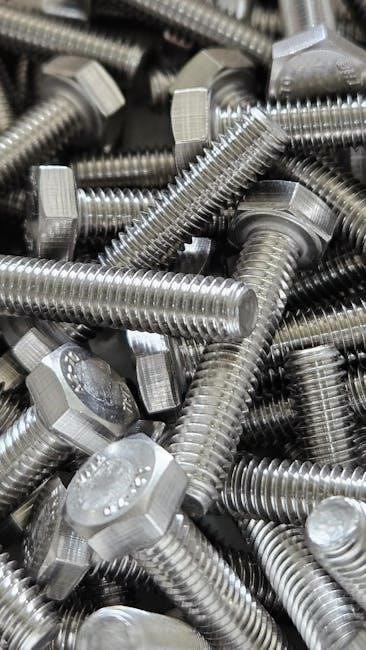
Safety Considerations When Selecting Flange Bolts
Proper torque specifications, detailed in PDFs, are crucial; material compatibility prevents corrosion. Bolt size and length impact system integrity and safety.
Always consult ASME B16.5 and manufacturer data.
Proper Torque Specifications
Achieving correct torque is paramount for a secure flanged joint, preventing leaks and ensuring structural integrity. PDF resources, like manufacturer specification sheets and ASME B16.5, detail precise torque values based on bolt size, material grade, and flange class.
Under-torquing can lead to gasket failure and leakage, while over-torquing risks damaging the bolts or flange itself. Torque specifications often account for lubrication and washer usage. Utilizing calibrated torque wrenches is essential for accurate application. Always refer to the relevant documentation for the specific flange and bolt combination to guarantee safe and reliable operation.
Consistent torque application across all bolts is vital for even gasket compression.
Material Compatibility
Selecting compatible materials for flanges, bolts, and gaskets is crucial to prevent corrosion and ensure long-term reliability. PDF documentation, including manufacturer specifications and standards like ASME B16.5, outlines suitable material pairings based on the conveyed fluid and operating environment.
Galvanic corrosion can occur when dissimilar metals are in contact, especially in the presence of an electrolyte. Careful consideration must be given to the chemical composition of each component. Stainless steel bolts, for example, should be paired with compatible flange materials to avoid corrosion issues. Always consult material compatibility charts before final selection.
Proper material choices minimize the risk of failure and maintain system integrity.